

Agricultural Organizations and Eastern Ontario Municipalities Call for a More Thoughtful Approach to Conservation Authority Reform
Eastern Ontario — Agricultural organizations and the member municipalities of South Nation Conservation are raising serious concerns about the Government of Ontario’s proposal to eliminate Conservation Authorities and replace them with large, provincially controlled regional agencies.
While partners across the region support modernization and stronger support from the Ministry of the Environment, this proposal represents the most significant environmental governance change in Ontario in 80 years and is moving forward without the time, transparency, or collaboration required for success.
Local Conservation Authorities are trusted, community-built institutions that manage land and water resources while supporting agriculture, drainage, natural hazard management, and watershed stewardship. They were created by municipalities, funded by municipalities, and shaped over decades through partnerships with farmers, landowners, and community organizations.
Claims that farmers do not support Conservation Authorities do not reflect the experience in Eastern Ontario.
Farmers and rural municipalities value their local Conservation Authorities.
They value:
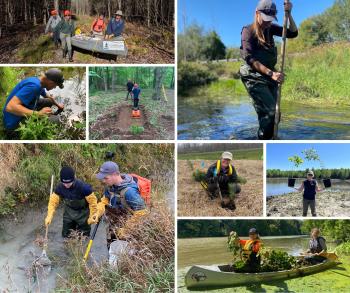
- Local staff with boots on the ground who understand regional soils, drainage systems, and farm operations.
- Timely, practical permitting and technical support that helps advance sustainable development and environmental protection.
- Stewardship and cost-share programs that make water quality and natural resource improvements achievable.
- Local management of conservation lands that have been donated and entrusted for long-term conservation in perpetuity.
- Long-standing relationships built on trust, accessibility, and local knowledge.
In Eastern Ontario, Conservation Authorities are not distant regulators — they are partners. Farmers work for Conservation Authorities, sit on their boards, and collaborate directly on drainage, erosion control, water management, and land stewardship. The Province has also indicated for years that they will appoint additional agricultural representatives to Conservation Authority Boards and local partners call on the government to follow through on this commitment.
Agriculture and Conservation Go Hand in Hand
Healthy farms and healthy communities depend on healthy watersheds. Effective drainage, reliable water supplies, soil conservation, and protection from floods and drought are essential to farm viability and rural economies.
Local Conservation Authorities deliver these outcomes by working with farmers and municipalities — not through centralized, one-size-fits-all systems.
Recent Changes Have Already Shown the Risks
Eastern Ontario has already experienced the unintended consequences of removing local regulations, local expertise and shared service models, including:
- Rural municipalities forced to hire private consultants at higher cost and with longer timelines for natural heritage and hydrogeological reviews for services that used to be provided by Conservation Authorities.
- Regulations imposed without sufficient consideration of regional conditions, including development constraints in wetlands which is now required across Ontario, but with implementation paused in Eastern Ontario.
Further large-scale consolidation risks repeating these mistakes and jeopardizing the frontline services communities rely on.
Development Performance: Facts Matter
Claims that Conservation Authorities delay development are not supported by evidence — particularly in Eastern Ontario.
Local Conservation Authorities play a critical role in speeding up safe, sustainable development by identifying risks early, coordinating reviews, and working directly with municipalities, developers, and landowners. Effective regulation depends on decision-makers having first-hand knowledge of local conditions, including soils, drainage patterns, flood risk, and existing land uses.
In Eastern Ontario, performance data demonstrates that this system works:
- 100% of planning reviews are completed within municipal timelines.
- 100% of septic system permits are issued on time, and within 9 days on average.
- 98% of regulatory permits are issued within provincially mandated timelines.
- Conservation Authorities are only involved where natural hazards or environmental protections apply — not routine development.
These results show that local, watershed-based service delivery supports development rather than delays it. Centralizing permitting and technical review could remove local knowledge, slow response times, and introduce new uncertainty for municipalities and proponents.
The Province’s own Housing Affordability Task Force did not identify Conservation Authorities as a barrier to housing. The data confirms that reform should focus on strengthening what already works — not dismantling it.
Local Knowledge, Cultural Heritage, and On-the-Ground Capacity Matter
Eastern Ontario’s Conservation Authorities reflect the distinct cultural, environmental, and geographic realities of the region. South Nation Conservation is the only bilingual Conservation Authority in Southern Ontario, serving communities where French-language service is not only a legal requirement, but part of local identity and history.
The region spans 4,480 square kilometres between the St. Lawrence and Ottawa Rivers and includes unique soils prone to retrogressive landslides, flood-prone lowlands, and highly managed agricultural drainage systems. These conditions demand specialized, locally based expertise that cannot be replicated through centralized or distant decision-making.
Despite this complexity, provincial funding now represents only about 3% of Conservation Authority operations, with municipalities carrying the responsibility for protecting people, property, and natural resources. Municipalities are concerned the Province is applying the same consolidation playbook used for health agencies — a system that is provincially funded and still resulted in reduced responsiveness, fewer local offices, and diminished front-line services.
Eastern Ontario partners are clear: this model does not work for environmental management. Conservation Authorities represent the only environmental agencies with boots on the ground, and maintaining local offices, local staff, and local decision-making is essential to protecting communities, supporting agriculture, and responding quickly to natural hazards.
Environmental protection depends on people who know the land — and who are present in the communities they serve.
A Call for a More Respectful and Collaborative Path Forward
Agricultural organizations and Eastern Ontario municipalities are calling on the Province to slow down and take the time needed to get this right. Amalgamations cannot be undone when unintended consequences arise.
They urge the Province to:
- Support modernization efforts without dismantling local governance
- Consider smaller, regionally appropriate service areas if amalgamations are pursued
- Incentivize and support voluntary consolidations, rather than impose them
- Fund transition costs so frontline environmental and agricultural services are not disrupted
- Protect donor intent and local management of conservation lands
- Respect the local decision-making authority of municipal councils
- Protect rural representation in any new regional governance framework
Environmental management works best when decisions are made close to the land and the people who depend on it.
Strengthen What Works
Conservation Authorities in Eastern Ontario are effective because they are local, accountable, and embedded in the communities they serve. With appropriate collaboration, funding, and respect for municipal leadership, the Province has an opportunity to strengthen — not weaken — Ontario’s conservation system.
Agricultural organizations and municipalities stand ready to work constructively with the Province to improve services, modernize systems, and protect communities — but meaningful reform must be done with rural Ontario, not to it.